Tuesday, May 27, 2014

PREPAID ELECTRICITY METERS MAY REDUCE CONSUMPTION

Installing prepaid electricity meters in India will have a similar "transformative" effect that was seen in the telecom sector with prepaid services, as people would be able to manage their consumption better, a Sri Lankan think tank LIRNEasia today said. Discussing findings of survey on access to electricity covering India, Sri Lanka and Bangladesh, LIRNEasia, an ICT policy and regulation think tank, said that urban, low income micro-entrepreneurs (MEs) (0-9 employees) face issues in getting new connections and later on with the quality of service. "In India, six per cent of MEs who said they did not have a separate electricity connection for their business because they did not have the right documents. As a result, they obtained electricity from shared connections or illegal temporary connections, often at a high cost," LIRNEasia co-founding Chair Helani Galpaya told reporters here.
She added that this issue can be addressed using prepaid meters and easing the procurement process.
"Since the cost of electricity is paid in advance, the service provider does not run the risk of financial liability and costs involved in issuing bills through meter reader is also avoided. Consumer can top up the meter through a reload system," LIRNEasia co-founding Chair Rohan Samarajiva said.
The model has seen success in the telecom industry and has a potential to transform the electricity distribution system too, he added. The body is meeting state-level energy regulators from Bihar, Gujarat and Maharashtra to discuss the findings of the survey, which covered 1,279 people in India (Delhi and Patna).
Samarajiva also highlighted that use of mobile phones in communicating with customers about planned power cuts and complaint receipts can also play an important role in improving quality of service.
"Among the three nations, India had the highest number of people saying they received no communication in advance about power outages. Also 64 per cent of Indian MEs said they refrained from complaining as they felt there was no use. There are problems that can be addressed using SMS and make discoms more accountable to the public," he said.

NIFTY OUTLOOK FOR 28th & REVIEW

FORENOON BETTER...PROFIT BOOKING TOWARDS CLOSE...

Nifty continues correction for the Second day in a row but closed above 7300 mark. Stop loss for Nifty may be maintained at  7265 (on close basis). Scrip specific movement can be expected in view of the last Two days of Derivative settlement. While Global cues, Quarterly results   and  Funds flow  are expected to broadly guide the market movement, based on the present market position , market can be expected to  be generally better in the forenoon and might encounter selling pressure in the closing session.

Nifty                               7318  -41

Review for Tuesday :: Narrow Movements… General Bearish Bias… !!!

Market traded with negative bias through out the day and closed with a loss of more than 0.60%. 30 of Nifty stocks ended in the red and broader market too was weak with Advance Decline ratio at about 1:1.7. IT, Media, Metal, Pharma indices gained while PSU Bank, Energy, Realty, Auto and Infra indices closed weak for the day. Infy, HDFC Bank, L&T contributed about 15 20 points to Nifty’s gain while  HDFC, Reliance, SBI     dragged down by more than 20 points.
 
Jindal Steel, Tech Mahindra, Tata Steel, Infy, Lupin   remained gainers  among Nifty stocks while GAIL, BHEL, PNB, Bank of Baroda, IDFC   remained  major  losers.
  
Bharat Forge Jindal Steel, Just Dial, Havells, Aurobindo     remained major  gainers  among F&O stocks while GAIL, Unitech, IFCI, PFC, BHEL   declined among F&O stocks.

PROFIT BOOKING RATTLES MARKET

he benchmark Sensex today retreated from a record and fell for the first time in four days weighed down by selling in power and oil shares as Prime Minister Narendra Modi allotted portfolios to his council of ministers. Mixed global cues with downward bias amid offloading of positions by foreign funds in view of monthly equity derivatives expiry also impacted the market, a broker said. The BSE 30-share barometer resumed slightly better, but fell back immediately and remained in negative for rest of the day to end at 24,549.51, a fall of 167.37 points or 0.68 per cent. In previous three days, it had gained 418.86 points, or 1.72 per cent, to end at record closing high of 24,716.88. "Possibly, profit booking coupled with disappointment over the appointment of key ministries could have led to market decline. All indices were in red except IT, Metals and Healthcare," said Sanjeev Zarbade, Vice President- Private Client Group Research, Kotak Securities. The broad-based NSE 50-issue CNX Nifty also dropped 41.05 points, or 0.56 per cent, to end at 7,318.00. A narrowing current account deficit at 1.7 per cent of GDP in FY'14 from 4.7 per cent in FY'13 was apparently ignored by market participants, said equity dealers. Selling activity was seen picking up in mid and small-cap stocks largely in line with overall trends, they added. Renewed capital outflows too affected the market sentiment. Foreign institutional investors (FIIs) sold shares worth a net Rs 84.13 crore yesterday as per provisional data from the stock exchanges. Gail India was the top loser from the Sensex pack with a fall of 7.56 per cent even as net profit rose year-on-year. Besides Gail India, HDFC, RIL, SBI, ONGC, M&M, Tata Motors, TCS and BHEL also suffered losses while Infosys, L&T, HDFC Bank, Tata Steel and Hindalco attracted buying. "With the derivatives expiry on Thursday markets are likely to be volatile. Even for initiating fresh shorts traders should wait for some pullback or consolidation to take place at higher levels," said Jayant Manglik, President-retail distribution, Religare Securities. 

MODI SWUNG INTO ACTION

BIG RESTRUCTURING OF MINISTRIES

In a restructuring of his Cabinet, Prime Minister Narendra Modi today combined 17 related ministries into seven different groups, including some infrastructure departments, in an apparent bid to ensure synergy and better results. First the Ministry of Overseas Indian Affairs, created in UPA-II, has been brought together with External Affairs Ministry under Sushma Swaraj while Corporate Affairs has been brought back to Finance under Arun Jaitley. In infrastructure sector, the Prime Minister has combined Road Transport and Highways and Shipping in the ministry to be headed by Nitin Gadkari, who had made a name for himself by adopting an innovative approach in expanding road transport network and bridges in Maharashtra when he was a minister there in BJP-Shiv Sena Government. Another important infrastructure combination is bringing together Power, Coal and New and Renewable Energy under the independent charge of Minister of State Piyush Goyal. These used to be separate ministries with Cabinet ministers incharge in the UPA governments. 
Related ministries of Urban Development, Housing and Poverty Alleviation have been placed under the charge of M Venkaiah Naidu, while Rural Development, Panchayat Raj and Drinking Water and Sanitation have been grouped together under the charge of Gopinath Munde. In another minor combination of ministries, Goa's Shripad Naik has been charge of Culture and Tourism as Minister of State with independent charge. However, this is not the first time that ministries have been brought together for the purpose of efficiency and homogeneity. Late Prime Minister Rajiv Gandhi brought together infrastructure department of Railways, Shipping and Civil Aviation under one combined ministry of Transport headed by the late Bansi Lal. He had three Ministers of States to help him. Gandhi also clubbed education, culture and women and child development under the Ministry of Human Resources Development under late P V Narasimha Rao. The HRD ministry was created for the first time then. Former Prime Minister Atal Bihari Vajpayee during his tenure had brought Information Technology and Communication under one umbrella while his successor Manmohan Singh had brought together Surface Transport and Shipping.

MUMBAI FAVOURITE PLACE FOR UAE NRI's

Mumbai has emerged as the top Indian city for property investments by NRIs in the UAE with Bangalore being the second most popular, according to a survey. Mumbai retained the top spot with 31.86 per cent NRIs preferring to make property investments in the city, a recent survey on Indian properties by Sumansa Exhibitions, the organisers of the Indian Property Show in Dubai, said. Bangalore came in second with 24.35 per cent preferring to invest in residential property in the coming months, the survey said. Chennai and Pune jointly hold the third place with almost equal percentage of people preferring these cities. Delhi has the fourth position followed by Cochin, Navi Mumbai, Gurgaon and Hyderabad. "Bangalore's property market bucked the trend in other metros with many new launches, good demand and resilient prices. Sector experts predict that residential property in the city will remain a good bet for 2014, too," said Sunil Jaiswal, CEO Sumansa Exhibitions. "Bangalore is the third-largest real estate investment hub for High Net worth Individuals (HNIs) and tops the list in terms of investments from Non Resident Indians (NRIs) looking at settling down in India in the future", said Jaiswal. "With a high net-worth individuals population of about 10,000 the third highest in the country after Delhi and Mumbai Bangalore's super-luxury segment is also worth watching," he said. The property exhibition organised by the group will be held from June 12 to 14. According to the survey, 31 per cent NRIs looking for properties in the price range of 76 lakhs and above, 52.57 per cent look for mid segment range of 26-75 lakhs and demand for high end segment, 1 crore plus, is at 16 per cent. Residential apartments are all time favourite with 77.17 per cent interested in buying one, compared with villas or commercial property. The highest number of buyers is in the age group of 36-50 years at 67 per cent, the survey said adding that 72 per cent buyers aim for immediate purchase within next 6 months. More than 14,700 NRIs from across UAE participated in the survey.

NEXT 30 DAYS BEST FOR REALTY INVESTMENT


Nearly 60 per cent of Indians think that next one month would be a good time to buy real estate with improvement in consumer sentiments following formation of a stable government, according to a survey by global research firm Ipsos.
"Almost six in ten (57 per cent) Indians think the next 30 days will be a good time to buy real estate, such as a house, vacation property or investment property," Ipsos said in a statement.
Founded in France in 1975, Ipsos is an independent market research company controlled and managed by research professionals.
"With the formation of a new stable government at the Centre, the consumer sentiment which was low in the last 2 years has improved significantly. The stock market has already reacted in a positive manner reflecting this change, the real estate prices are expected to go northwards by the end of the year," said Bhasker Canagaradjou, Associate Director, Ipsos Business Consulting. The realtors reeling under large scale of debt are offering discounts to reduce their inventory levels taking advantage of the new found optimism in the market. The residential real estate market may see an uptick in the demand and increase in the number of transactions in the near future, he added. Majority (65 per cent) of people in Russia think next 30 days would be a good time to buy property followed by India (57 per cent), Indonesia (55 per cent), Ireland (51 per cent), Great Britain (47 per cent), Mexico (44 per cent), Australia (42 per cent), Hungary (42 per cent). "Those rounding out the middle of the pack are from the United States (41 per cent), Germany (40 per cent), Canada (39 per cent), Italy (38 per cent), Argentina (37 per cent), South Africa (37 per cent), Sweden (37 per cent), Poland (35 per cent) and Spain (34 per cent). The survey was conducted in 26 countries with a total sample of 20,144 adults age 18-64 in the US and Canada, and age 16-64 in all other countries.

NET CAPITAL INFLOWS RISE SHARPLY

The net capital inflows to India are likely to increase sharply in FY'15, buoyed by the historic victory of the BJP-led NDA headed by Prime Minister Narendra Modi, says a Nomura report. According to the global financial services firm, this historic victory has enthused investor confidence that the government will pursue reforms and policies that will put India back on high growth trajectory over the medium term. "We expect a USD 25 billion balance of payments surplus in FY'15," Nomura said in a research note. According to the report, the import bill is likely to rise slightly on gradual relaxation in gold import restrictions and the non-gold import bill may also rise slightly as growth picks up in the latter half of FY'15. The rise in import bill will be offset by strong exports on the back of higher global demand, it said. "Overall, we expect the current account deficit (CAD) to remain within sustainable levels, under 2 per cent of GDP in FY'15," the report said. According to RBI data released yesterday, in FY'14, CAD narrowed to 1.7 per cent of GDP, or USD 32.4 billion, from 4.7 per cent, or USD 87.8 billion, in the previous fiscal. The decline in the deficit continues to be driven by lower gold imports and softer non-oil, non-gold demand, which helped contain the merchandise trade deficit, experts said. British brokerage firm Barclays also believes that given the government's measures to restrict gold imports largely remain in place, we do not think the current account deficit will widen significantly in the first half of FY'15. CAD is expected to be lower than the earlier forecast of USD 50 billion (2.4 per cent of GDP) in FY'15. India's current account deficit narrowed sharply to USD 1.2 billion, or 0.2 per cent of GDP, in Q4 of FY'14 from USD 18.1 billion, or 3.6 per cent of GDP, a year ago. In the December quarter, it stood at USD 4.2 billion or 0.9 per cent of GDP. The lower CAD was primarily on account of a decline in trade deficit as imports fell sharper than exports.

Monday, May 26, 2014

CARNIVAL ATMOSPHERE

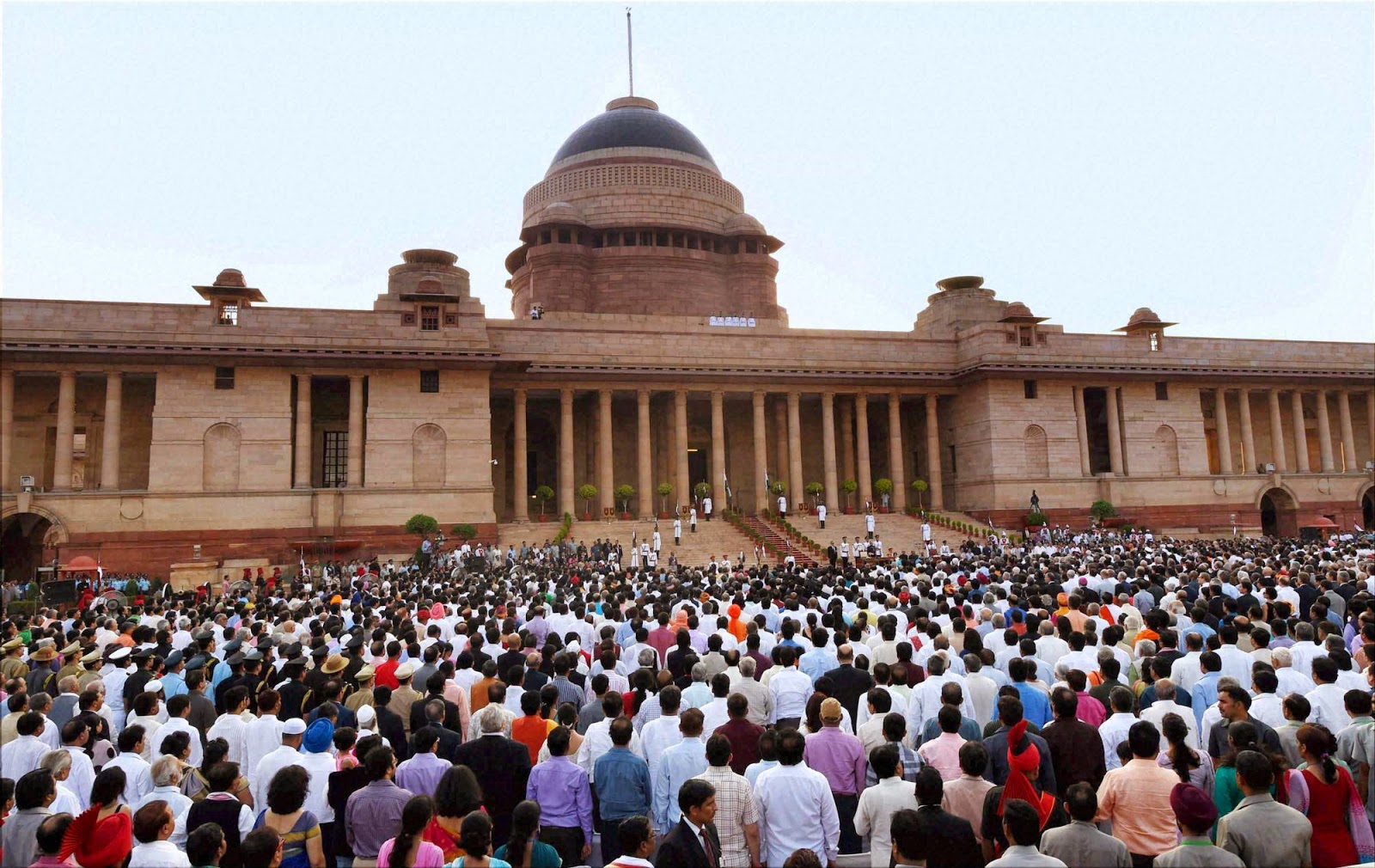
he occasion was ceremonial but it was a carnival atmosphere as Narendra Modi was sworn in as Prime Minister before the largest-ever gathering at Rashtrapati Bhawan, which became a confluence of people as varied as Presidents, Prime Ministers, film stars, corporate and religious leaders.

Never before have well over 4000 people gathered in the forecourt of the majestic Presidential house as they did today to watch the change of guard from Manmohan Singh to the man from Gujarat for whom the oath-taking ceremony was the culmination of a breathtaking political journey.
The heat did not deter the Modi admirers who had come hours ahead. There were a few fans to cool them but they mostly depended on their invitation cards to generate some breeze till the sun set and made it bearable.
'Modi, Modi' up went the chants when the PM-designate arrived shortly before 6 PM as if this was yet another of his election gatherings that the nation had witnessed over the past many months.
Before Modi arrived, his special guests from abroad--Prime Minister Nawaz Sharif of Pakistan, Nepal PM Sushil Koirala, Sri Lankan President Mahinda Rajapakse and other SAARC leaders--had taken their front-row seats. As each name was announced there were cheers, the loudest being reserved for the Pakistani leader. 

Wearing a pastel-coloured Nehru jacket over a full-sleeved off-white Kurta and sporting a tri-coloured badge, Modi took oath in Hindi in the name of God. He was lustily cheered. The next to take oath was Rajnath Singh, the leader seen most with the new Prime Minister during the election campaign. He was followed by another party veteran Sushma Swaraj and then Arun Jaitley. 
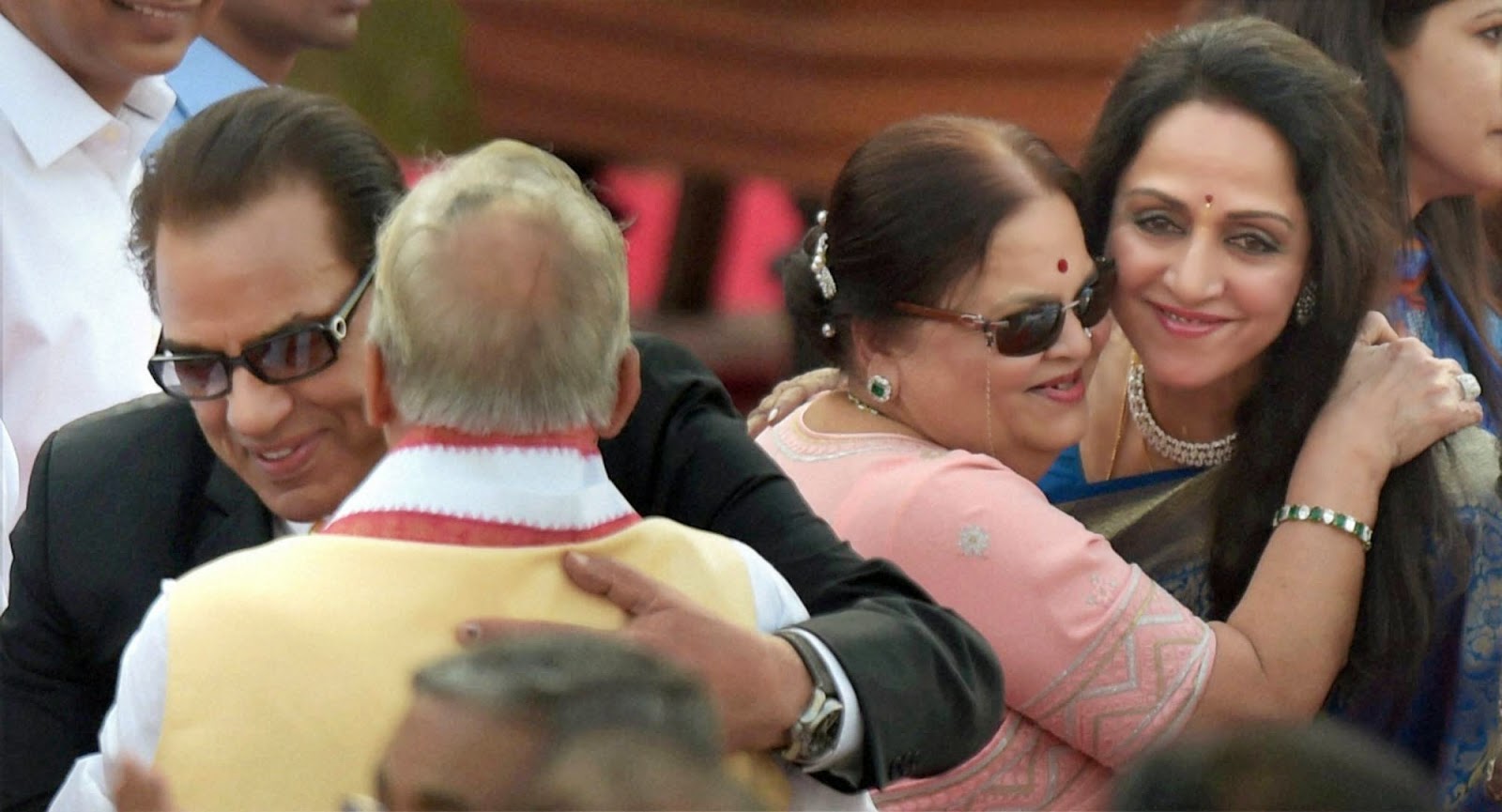
Modi became the third Prime Minister since Atal Bihari Vajpayee and Chandra Shekhar to assume the top office in the sprawling red-sand forecourt. The glamour quotient in the ceremony came from cinestars Salman Khan and Vivek Oberoi, actor-turned-politicians Hema Malini and Shatrughan Sinha, who have been elected in the recent elections, and her husband Dharmendra, who were all seen enjoying the moment. The presence of large number religious gurus, many of whom added saffron tint to the ceremony, including Sri Sri Ravi Shankar, Morari Bapu, Jagadguru Rambhadracharya, Sadhvi Rithambara was prominent in the front row of guests. While Mukesh Ambani was accompanied by his wife Nita and two sons, his brother Anil brought his mother Kokilaben. Gautam Adani also came with his family.
SP President Mulayam Singh Yadav, Uttar Pradesh Chief Minister Akhilesh Yadav, Jammu and Kashmir Chief Minister Omar Abdullah were also present in the ceremony but Tamil Nadu Chief Minister J Jayalalitha, West Bengal Chief Minister Mamata Banerjee and Odisha Chief Minister Navin Patnaik gave it a miss.  

 
RELEASING BALLONS
LIGHTING CRACKERS
DHIONI @ CEREMONY

FORECOURT
DHARMENDRA, JOSHI, HEMAMALINI, KOILA BEN
GAVASKAR, SALMAN
SATRUGHAN SINHA, ANUPAM KHER, HEMAMALINI
SONIA RAHUL
ANIL, POONAM THILLON

MORGAN STANLEY PREDICT RETURN OF RETAIL INVESTORS


Domestic markets may see the return of retail investors finally as earnings from equities have turned positive in recent months, brokerage firm Morgan Stanley said in a report today. Retail investors could become net buyers soon from being net sellers for long, it said, adding that financial savings should see a boost in the coming 24 months if the government commits itself to bringing down inflation leading to a marginal rise in real rates, which in turn will help the retail segment to remain invested. The share of equities within that could also rise given the improving real return on equities and the starting point of equity ownership relative to fixed income, it added. The anchoring to physical assets, especially gold, is likely to be shaken in the coming months, the report said. Morgan Stanley said the low and negative real rates of the past four years have fuelled demand for gold and property. Gold demand has historically not been as high as it has been in the past five years. "Now, we think real rates may continue to rise largely due to tempering of inflation - this means property and gold will give up share in total savings," it said. The mix of equities in financial savings is driven by trailing real equity returns. Trailing returns are rising and this is good for equity flows. In addition, the other factor is the ratio of equities to fixed income, this ratio shows very high under-allocation to equities. Already, India has underlying structural factors to drive equity savings. Choice between equities and gold is driven also by the relative returns of the two asset classes. The equities are gaining at the expense of gold and, therefore, the relative equity flows to gold could also reverse in the coming months. While property has strong underling demand driven by nuclearisation of families, need for better housing and good affordability (house prices relative to incomes), the investment demand for homes could also come under relative pressure as households make a shift in favour of financial assets, it said.

MODI SWORN IN AS 15th PRIME MINISTER OF INDIA

Marking the beginning of a new era in Indian politics, Narendra Modi was today sworn in Prime Minister at the head of a 45-member coalition government after the elections threw the first government with absolute majority in 30 years.
SIGNING IN THE BOOK
63-year-old Modi, the first leader to get a landslide majority for BJP on its own, became the 15th prime minister in a virtual 'coronation' ceremony in the forecourt of the Rashtrapati Bhawan before a 3000-strong gathering, the largest audience at the swearing in a of new government.
Rajnath Singh, Sushma Swaraj, Arun Jaitley, M Venkaiah Naidu, Nitin Gadkari, Uma Bharti, Maneka Gandhi, Ananth Kumar, Ravi Shankar Prasad, Smriti Irani and Harsh Vardhan were among those who were sworn in as Cabinet ministers.
Ram Vilas Paswan (LJP), Harsimrat Kaur Badal (Akali Dal), Anant Geete (Shiv Sena) and Ashok Gajapathi Raju (TDP) were those from allied parties who took the oath today.
Dignitaries from politics, industry, cinema and religion, capped by leaders of SAARC nations including Pakistan Prime Minister Nawaz Sharif, watched Modi take the oath of office and secrecy in Hindi.


RELAUNCH OF OFFICIAL WEBSITE

Seconds after Narendra Modi was sworn-in as Prime Minister, the PMO website was relaunched carrying his message seeking support, blessings and active participation of the people who, he said, have delivered a mandate for development, good governance and stability.
"Together we will script a glorious future for India... As we devote ourselves to take India's development journey to newer heights, we seek your support, blessings and active participation," Modi said in his first message on the official website. He also said " Let us together dream of a strong, developed and inclusive India that actively engages with the global community to strengthen the cause of world peace and development." Various new sections have been introduced on the entirely revamped official website of the Prime Minister's Office and include a category on Modi's personal life. A short profile was also uploaded on www.pmindia.nic.in which described him as "dynamic, dedicated and determined" leader who "arrives as a ray of hope in the lives of a billion Indians". It said his "laser focus on development and his proven ability" to deliver results have made him one of India's most popular leaders. Without naming RSS, it said that from a very young age, Modi immersed himself in service to the nation, working with "patriotic organisations". An option called "Wish the Prime Minister" takes a user to Modi's personal website. Underlining that the website was a very important medium of direct communication between him and people, he said "I am a firm believer in the power of technology and social media to communicate with people across the world". Modi hoped the platform creates opportunities to listen, learn and share one’s views. "Through this website, you will also get all the latest information about my speeches, schedules, foreign visits and lot more. I will also keep informing you about innovative initiatives undertaken by the Government of India," he said. The website also has a section on his personal life which includes various phases from being a young child to RSS volunteer to BJP leader. 

MODI MOTHER WATCH LIVE IN TV

MODI MOTHER LIVE WACHING
Prime Minister Narendra Modi's mother Hiraben, who could not attend her son's swearing-in ceremony at Rashtrapati Bhavan today, ensured she keeps pace with the developments on television. Sitting in a small room with her family members, 92-year-old Hiraben watched live coverage of the gala event. She seemed unperturbed by scores of cameramen and reporters who had crowded the room to seek her reaction. Modi was blessed by his mother at her home in Gandhinagar after BJP won the electoral mandate to form the next government at the Centre. "He has my blessings and he will lead the country towards development," she had said after blessing her son. She stays with her other son Pankaj Modi in Gandhinagar.  
FORE COURT OF PRESIDENT PALACE
NEW MINISTRY
TRIBUTE TO MAHATMA
PAYING TRIBUTE TO FATHER OF THE NATION
JUBILANT BOY
OFFERING ARTI
MODI FAMILY
OFFERING SWEETS
MODI PROFILE

HEPTHULLA OLDEST & SMRITI IRANI OLDEST IN CABINET

TEAM MODI
Both the youngest and the oldest members of the Narendra Modi Cabinet happens to be women - Smriti Irani and Najma Heptullah. While Irani is 38 years old, Heptullah is 74. Incidentally, both of them are from the Rajya Sabha representing Gujarat and Madhya Pradesh respectively. Irani, who had unsuccessfully contested against Congress Vice President Rahul Gandhi in Amethi, has been sworn-in as Union Cabinet Minister as is Najma. A former National President of BJP's women's wing, Irani now holds the position of Vice President in the party. Irani was born in Delhi and had her education in the national capital before she shifted to Mumbai and became a household name because of her role in the TV serial "Saas Bhi Kabhi Bahu Thi" for her portrayal of the character of Tulsi. Heptullah was Deputy Chairperson of Rajya Sabha and had shifted to BJP from Congress. The other women members of the Union Cabinet include Sushma Swaraj, Uma Bharti, Maneka Gandhi and Harsimrat Kaur Badal.

DIVIDEND PAYMENTS THROUGH BORROWED MONEY

Aggressive dividend payouts by top 500 companies has seen 419 of them together borrowing around Rs 20,000 crore, while paying around Rs 1.2 trillion (Rs 1.2 lakh crore) in FY'14, according to India Ratings. "Several BSE 500 corporates, excluding banks and financial services companies, adopted an aggressive dividend payment strategy in FY'14, despite a reduction in their net profit. "We expect 419 of these corporates to have paid an aggregate dividend of Rs 1-1.2 trillion in the fiscal and availed aggregate debt of Rs 18,000-20,000 crore for the same," as per the data collated by the rating agency. The agency estimates 419 corporates availed Rs 19,180 crore of debt in FY'14 to fund the aggregate dividend payment of Rs 1,04,900 crore. The trend of dividend payment behaviour over FY'09-FY'13 suggests that in most instances cash flow from operations was adequate and instances of debt requirement declined steadily from FY'11-FY'13. "However, the total quantum of debt needed rose sharply in FY'13 (after declining in FY'12) due to an increase in dividend payments and a reduction in net profit. As many as 37 public sector units among the 419 corporates paid aggregate dividend of Rs 45,060 crore in FY'13, and of these, eight of them had to borrow Rs 12,890 crore to make the payments. However, considering the sovereign linkage of these companies, their credit profiles are unlikely to be impacted, it added. But more worrisome may be the case of 12 private corporates with high leverage (above 5 times) which could have borrowed an estimated Rs 2,770 crore to pay dividends. Lenders have to watch out for corporates whose cash flow from operations (CFO) is negative or have CFO below the amount of divided paid, while PAT may be positive. In some of these cases, dividend payments could be financed by debt, even when financial leverage is high. As such, some loan documents have covenants with respect to dividend payments, but they usually require the borrower to inform or seek approval from bankers before paying dividends. Decision triggers are usually accounting profit, balance sheet net-worth or debt/equity ratio. Under the new Companies Act, a corporate can pay dividend out of its current or past accounting profit, in essence out of net income. However, it is possible that while a corporate can generate positive net profit, its CFO may be negative due to high working capital requirements to support revenue and EBITDA profits. In such cases, a company paying dividend higher than its CFO is likely to tap its cash reserves, investments and non-recurring income. If this is insufficient, the company would effectively rely on debt to finance dividends. Reliance on cash reserves or debt to partly or fully fund dividend payments has a negative impact on net leverage (adjusted debt net of cash dividend/EBITDA) and the overall credit profile, it added.

à°°ెà°ªోà°°ేà°Ÿు à°¯‌à°¥ాà°¤‌à°¥ం

à°ª‌à°¶్à°šిà°®ాà°¸ిà°¯ా à°¸ంà°•్à°·ోà°­ం à°ª్à°°‌à°¤్à°¯ేà°•ింà°šి à°…à°®ెà°°ిà°•ా-ఇరాà°¨్ à°¯ుà°¦్à°§ం à°ª్à°°‌à°ªంà°š ఆర్à°¥ిà°• à°µ్యవ‌à°¸్à°¥‌à°²‌à°¨ు à°­‌à°¯ à°•ంà°ªిà°¤ుà°²్à°¨ి à°šేà°¸్à°¤ుà°¨్à°¨ à°µాà°¤ాà°µ‌à°°‌à°£ంà°²ో à°­ాà°°‌à°¤ à°°ిà°œ‌à°°్à°µ్ à°¬...